


Discover opportunities for Japanese spirits in Germany and why Bar Convent Berlin is the key trade fair for European market entry.
Germany remains one of Europe’s most attractive premium spirits markets1, but market entry is becoming more complex as overall alcohol consumption continues to decline. With changing consumer preferences, success increasingly depends on strong positioning, category education and early access to distributors and the on-trade.
For Japanese SMEs, Bar Convent Berlin (BCB) is not only a trade fair but a selection point for European distributors deciding which new brands to introduce into their portfolios.
Japanese whisky is already well established and has created a strong trust base for Japanese spirits. This opens the door for categories such as shochu, awamori, Japanese craft gin and premium liqueurs.
Table of Content
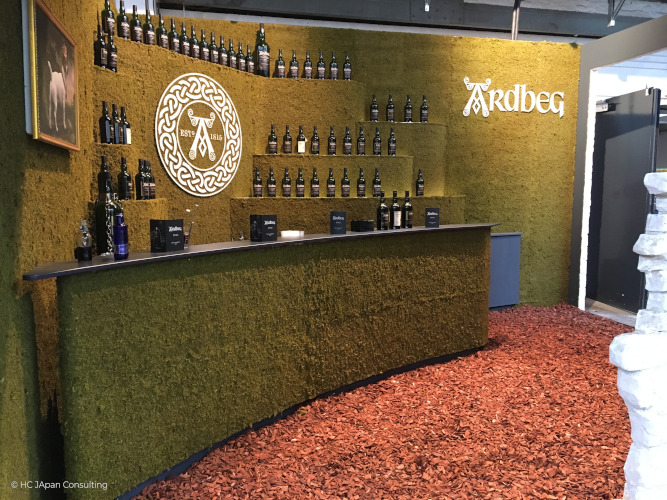
Ardbeg Booth at BCB – Project managed by Caroline Hayashi
Germany: A Large but Selective Premium Market
Germany is Europe’s largest economy with over 84 million inhabitants2 and a GDP of more than USD 5.4 trillion3. It remains a core market for alcoholic beverages and a strategic entry point into the wider EU.
The distribution system is highly developed, with more than 36,000 food retail outlets4, strong beverage specialist retail, wholesalers, and a large HoReCa sector.
At the same time, consumption patterns are changing. According to BMEL, per capita alcohol consumption has declined from around 137 litres in 2010 to below 115 litres today5. Beer, the largest segment, is in long-term decline, wine is stabilising at lower levels, and spirits face increasing pressure from low- and no-alcohol alternatives.
Implication: Germany is no longer a volume-driven market. It is a selection market, where clearly positioned premium products can gain traction.
Three Market Shifts That Matter for Japanese Spirits
1. Premiumisation: Fewer Occasions, Higher Value
Despite declining consumption, consumers are willing to pay more for products with quality, craftsmanship and authenticity. Premium spirits are increasingly linked to gastronomy, social occasions and experience rather than everyday consumption.
For Japanese producers, this is a structural advantage. Japanese whisky has already established a strong reputation for craftsmanship and quality, providing a foundation for other premium spirits from Japan.
2. Sober-Curious Consumption: Lower Frequency, Lower ABV
Health awareness and changing lifestyles are reshaping drinking behaviour, particularly among younger consumers. Many are drinking less frequently or choosing low- and no-alcohol alternatives without sacrificing quality or experience.
This shift creates demand for spirits suited to lighter serves and lower-ABV cocktails. Shochu, with its moderate alcohol content, and Japanese liqueurs fit well into this trend, offering flexibility and balance in modern drinking occasions.
3. Experience-Driven Drinking: From Habit to Occasion
The most significant shift is not what consumers drink, but how they drink. Alcohol is moving away from daily habit consumption toward occasional, experience-led usage. Dining out, cocktail bars and aperitivo-style social settings are replacing at-home routine drinking, while drinks such as Aperol Spritz or Hugo reflect demand for lighter, refreshing serves.
For Japanese spirits, this opens opportunities beyond whisky. Japanese craft gins, shochu, umeshu and yuzu liqueurs align well with cocktail and spritz culture through their flavour profiles, versatility and premium positioning.
Market Opportunities for Japanese Spirits
Japanese whisky has established Japan as a producer of premium spirits in the German market. At the same time, the rising popularity of Japanese cuisine—from sushi and ramen to izakaya and modern dining concepts—has strengthened broader interest in Japanese food and beverage culture. This creates favourable conditions for Japanese premium spirits.
For many of these products, the main barrier is not quality but awareness. Unlike whisky, categories such as shochu and awamori often require explanation regarding production methods, taste profiles and serving occasions. Building this understanding among importers, distributors, bartenders and retailers is essential for market entry.
Why Bar Convent Berlin Matters
For spirits companies entering Germany or Europe, Bar Convent Berlin (BCB) is one of the industry’s key meeting points.
BCB, which celebrates its 20th edition in 2026, has become a leading global trade fair dedicated to premium spirits. Each year, it attracts around 15,000 trade visitors from more than 80 countries and over 500 exhibitors, including producers, distributors, importers, bartenders, retailers and hospitality professionals. Unlike general trade fairs, BCB is highly focused on the on-trade and premium bar ecosystem.
For Japanese producers, this means:
- direct access to distributors actively looking for new brands
- real-time feedback on positioning and pricing
- visibility among bartenders who influence consumer demand
- early validation of market potential in Europe
Japanese whisky brands such as Suntory and Nikka are already present, reinforcing category credibility and lowering barriers for new Japanese entrants.
Making a BCB Participation Work
For Japanese SMEs, BCB is not a standalone marketing event. It is a structured market entry project.
Success depends on three phases:
Before the fair: access creation
The most important work happens before arrival in Berlin. This includes identifying potential distributors, scheduling meetings in advance, and preparing clear product messaging adapted to European buyers.
During the fair: conversion
Booth traffic alone is not sufficient. Successful participation depends on structured meetings with pre-identified partners and clear communication of product positioning.
After the fair: follow-up
Most commercial outcomes are not decided at the fair itself, but in the weeks after. Systematic follow-up, sample tracking and distributor discussions determine whether interest becomes business.
Where local support matters
For companies entering Europe for the first time, on-the-ground support in Germany can significantly reduce execution risk, save valuable time and intercultural pitfalls.
This typically includes:
- in-depth briefing about local trends and market overview
- identifying and pre-qualifying distributors before BCB
- scheduling targeted meetings with buyers
- coordinating booth construction and logistics (incl. Hotel and transportation coordination)
- managing sample shipments and on-site operations
- providing interpretation during commercial discussions
- supporting structured post-fair follow-up with potential partners
The objective is not participation itself, but conversion of trade fair activity into distribution relationships.
Considering the German Market or preparing for Bar Convent Berlin?
Every successful market entry starts with the right preparation.
We support Japanese producers with market intelligence, distributor outreach, trade fair preparation and local project coordination—helping turn exhibition participation into long-term business opportunities.
- https://www.spirituosen-verband.de/pressemitteilung/jahresbilanz-des-bundesverbandes-der-deutschen-spirituosen-industrie-und-importeure-e-v-bsi-2024-mit-ausblick-auf-2025-spirituosenbranche-mit-licht-und-schatten-herausforderungen-der-branche-sind-nunmehr-deutlich-erkennbar ↩︎
- https://www.destatis.de/DE/Themen/Gesellschaft-Umwelt/Bevoelkerung/Bevoelkerungsstand/Tabellen/zensus-geschlecht-staatsangehoerigkeit-2025.html?nn=2110 ↩︎
- https://www.imf.org/external/datamapper/NGDPD@WEO/WEOWORLD As of June 2026 ↩︎
- https://www.bmel-statistik.de/ernaehrung/ernaehrungsgewerbe/lebensmitteleinzelhandel ↩︎
- https://www.bmel-statistik.de/ernaehrung/tabellen-kapitel-d-und-hiv-des-statistischen-jahrbuchs 4090600-0000.xlsx Verbrauch von Getränken je Kopf ↩︎